
Ganesh mandals in Mumbai have requested the Maharashtra government to clarify the implementation of a recent Bombay High Court order on noise pollution during immersion processions. The order mandates a Rs 1 lakh security deposit and legal action for violations, causing confusion among organisers as the festival concludes.

Police in Latur, India, have registered seven cases related to noise pollution against organisers of Ambedkar Jayanti processions for violating noise pollution norms.

Police in Gurugram have booked two club operators for allegedly disturbing residents by playing DJ music at high volume late at night. Authorities seized music systems and speakers from the clubs after receiving complaints.

The Brihanmumbai Sarvajanik Ganeshotsav Samanvay Samiti has appealed to Ganesh mandals in Mumbai to ensure that immersion processions on the final day of the festival are free from noise pollution and inconvenience, citing the Bombay High Court's strict stance on decibel limits.

'Many devout religious people have told me categorically that they like celebrating festivals, but they are vehemently against the noise pollution and traffic obstruction that are being imposed under the pretext of celebrations.'
A case was registered against IPL organisers for allegedly violating noise pollution norms during the semi-final match played at D Y Patil stadium in Navi Mumbai on Thursday, police said.

The Bombay High Court has imposed a complete ban on firecrackers, loudspeakers, DJs, and laser beams on public roads during festival processions, criticising the Maharashtra government for its laxity in implementing noise pollution rules. The court highlighted the severe noise and air pollution caused by such celebrations and called for more dignified ways of observing festivals, noting that current permissions are often ineffective due to official inaction.
A new study by the Council of Scientific and Industrial Research (CSIR) has developed an integrated land-use regression (iLUR) model to map environmental noise across Delhi. This innovative approach combines geographical and real-time traffic data, including vehicle counts, speeds, and honking, to provide a more accurate and cost-effective understanding of noise distribution in the city's complex urban landscape. The model aims to help authorities plan targeted measures for noise control.

Maharashtra ministers are divided over the use of high-decibel DJ systems during Hindu festivals. While Minister Yogesh Kadam asserts that festival sound will not be stopped, his colleagues Sanjay Shirsat and Meghana Bordikar advocate for adherence to noise pollution norms, with Bordikar citing a personal tragedy. Chief Minister Devendra Fadnavis has also called for a return to traditional celebrations and a consensus on restricting DJ systems.
The city police has registered a case against Shiv Sena workers for flouting Noise Pollution Control Rules during the party's Dusshera rally, held at Shivaji Park in Mumbai. "A case under Bombay Police Act has been registered against the organisers of the rally for exceeding the 50 decibel noise level," Assistant Commissioner of Police Madhukar Sankhe told PTI.

Hundreds of Pune residents have protested against the use of loud music and DJ systems during the upcoming Ganesh festival, citing health issues and noise pollution. Ganesh Mandals, however, claim selective targeting and have pledged to follow guidelines to reduce noise.

The focus of the average Indian on water and air quality, and emerging urban concern with noise pollution have quite understandably relegated concerns about climate change to the background.

The Bombay High Court has issued a complete ban on bursting firecrackers on public roads and deemed the use of loudspeakers, DJs, and laser beams during religious processions "unwarranted." The court emphasized that festivals must be celebrated without causing noise and air pollution, highlighting the need for strict enforcement of existing regulations.
India needs campaign against noise pollution with rising audible assertion of upwardly mobile, says Sanjaya Baru.

Indian Railways zones are implementing measures to curb the nuisance of passengers playing loud music or videos on mobile phones in trains and railway premises. Violators could face fines up to Rs 1,000 or imprisonment for up to six months. This move comes after numerous complaints and recent amendments to railway laws, though some passenger bodies express concerns about enforcement manpower.

Hundreds of Thane residents protested against a proposed Amazon data centre, citing environmental concerns, noise pollution, and excessive water and electricity consumption. Amazon stated compliance with environmental laws, assuring the facility would not strain local resources, but protesters remain unsatisfied, with a local MP also demanding a review.

West Bengal Chief Minister Shubhendu Adhikari has directed police to take strict action against the use of loudspeakers beyond permissible sound limits at religious places and events across the state.

In Pune, 31 prominent Ganapati mandals celebrated a "DJ-free" Dahi Handi, advocating for traditional instruments over high-decibel sound systems for upcoming festivals like Ganeshotsav. This initiative, led by Punit Balan, aims to preserve Maharashtra's cultural heritage and reduce noise pollution, gaining support from around 200 mandals and the Chief Minister.

Telugu actor Allu Sirish complained to Hyderabad Police about a temple playing loud music late at night, disturbing residents. He clarified his complaint was about civic sense, not religious devotion, after facing criticism from netizens.

A seven-year-old girl in Balrampur, Uttar Pradesh, died after allegedly collapsing due to loud music from a Ganesh immersion procession. Two individuals, the DJ owner and operator, have been arrested, and a police officer suspended for negligence. The incident has led to a ban on DJs during upcoming festivals in the municipal area.

The ICSE, however, maintained the board did not publish or prescribe textbooks, and that schools had to deal with the issue.

Police have granted permission for Congress leader Rahul Gandhi's 'Chhatron Ki Goonj' event in Pune, but with 30 stringent conditions, including prohibitions on 'objectionable' banners and directives to avoid hurting religious sentiments.

Vidyanand Bapat, a Pune-based activist advocating for a ban on high-decibel DJ systems and loudspeakers during festivals, was publicly assaulted by a man named Santosh Chavan while speaking to media persons.

Mumbai resonated with 'Ganpati Bappa Morya' chants and dhol-tasha beats as devotees immersed Ganesh idols on Anant Chaturdashi, the final day of the 12-day festival. Over 430 idols were immersed by noon, with no untoward incidents reported, as elaborate arrangements by police and BMC ensured smooth proceedings.

Union Minister Nitin Gadkari has expressed his determination to blacklist contractors and suspend officials responsible for delays and shoddy execution of infrastructure projects. He plans to personally inspect the delayed Mumbai-Goa Highway in October and urged the Goa government to develop roadside amenities and promote green initiatives along the route. Gadkari also highlighted the importance of infrastructure for economic growth and sustainable development.

Two NCPI MPs from Murshidabad, West Bengal, met with Chief Minister Suvendu Adhikari to express concerns over the removal of mosque loudspeakers, alleging police overreach and targeting of Muslims. They also sought his intervention to expedite hearings for approximately 27 lakh people excluded from electoral rolls, highlighting difficulties faced by genuine voters due to delays in tribunal decisions.
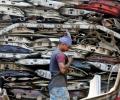
Latur police destroyed illegal vehicle accessories, including modified silencers and loud horns, worth Rs 9.18 lakh as part of a crackdown on noise pollution.

Former Supreme Court Justice Abhay Oka warned that major cities might be forced to adopt mandatory face mask usage within 20-25 years due to environmental degradation. He stressed that protecting the environment is a fundamental constitutional duty, countering the misconception that humans own the Earth. Justice Oka also encouraged students to study law and use AI responsibly.

Before protesting against the State, the citizen should not have to ask: Sir, may I protest, please?, asserts Prem Panicker.

Billions of rupees spent on river cleaning programmes have gone down the drain. This situation cannot be allowed to continue, says Business Standard.

'You can't be selfish when you're thinking about nature. It has to be good karma.' 'If we prevent textile waste from going to the landfills, it's good karma.'

According to a United Nations Environment Program 2022 report, these nine cities are known for particularly high sound levels.

The Bombay high court said on Wednesday that if the use of loudspeakers and sound systems beyond permissible noise levels was harmful during the Ganesh festival then it also has the same effect during the Eid-e-Milad-un-Nabi processions.

The Madras High Court has dismissed a petition seeking to prevent the Isha Foundation from conducting Mahasivarathri celebrations at its Coimbatore campus. The petitioner had alleged that the foundation lacked adequate sewage treatment facilities and caused noise pollution. However, the Tamil Nadu Pollution Control Board (TNPCB) informed the court that the foundation has adequate treatment facilities and complies with noise regulations. The court dismissed the petition, allowing the celebrations to proceed.

The police have launched a crackdown against the use of directional loudspeakers (devices that focus sound in a specific direction) at religious structures in Mumbai pursuant to a court order.

The Supreme Court of India has refused to relax the ban on firecrackers in the Delhi-NCR region, citing continued alarming levels of air pollution. The court emphasized the right to a pollution-free atmosphere as a fundamental right, stating that the ban is necessary to protect public health. The court also highlighted the issue of noise pollution caused by firecrackers. The decision comes after a batch of petitions were filed by firecracker manufacturers seeking relaxation of the ban.
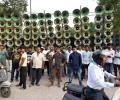
The Bombay High Court has ruled that the use of loudspeakers is not an essential part of any religion and has directed law enforcement agencies to take prompt action against loudspeakers that violate noise pollution norms. The court also ordered the state government to direct religious institutions to adopt mechanisms for controlling noise levels, including calibrated sound systems with auto-decibel limits. The decision came in response to a petition filed by two housing associations alleging police inaction against noise pollution caused by loudspeakers installed on mosques in the area.
The Delhi government on Monday permitted the use of loudspeakers and public address systems till midnight during Ramlila, Durga Puja, Dussehra and related events.

The petition, filed by Bajrang Dal leader Shaktisinh Zala, claimed that "noise pollution" caused by azan when played through loudspeakers affects people's, especially children's health and causes inconvenience otherwise.
The Maharashtra government on Friday announced that proposed flyovers and roads in Mumbai would have noise arresters to curb sound pollution.
